For many organizations, the conversation around Artificial Intelligence starts with fear.
“What if employees put confidential information into ChatGPT?”
“What if AI makes mistakes?”
“What if we violate compliance requirements?”
These are valid concerns, but they often lead organizations down the wrong path. Rather than creating a culture of innovation, they create a culture of avoidance.
The organizations realizing the greatest value from AI today are not asking whether they should adopt AI. They are asking how they can adopt it responsibly.
That’s where AI governance comes in.
AI Governance Should Enable Innovation, Not Prevent It
Too many AI policies read like a list of restrictions:
- Don’t use this.
- Don’t upload that.
- Don’t try these tools.
- Get approval before doing anything.
While controls are important, successful AI governance begins with a positive vision.
An AI Charter should serve as a declaration of intent, not simply a rulebook.
It should communicate something like:
“We are becoming an AI-driven organization.”
“We will empower every employee with AI tools that help them work smarter, serve customers better, and achieve greater success.”
“We will embrace innovation while protecting our customers, employees, and business.”
When employees understand that leadership is encouraging responsible AI adoption, they become partners in innovation instead of finding workarounds outside of IT’s visibility.
The Goal: Empower Every Employee
AI is not replacing employees. It is augmenting them.
Just as spreadsheets did not replace accountants and email did not replace communication, AI is becoming a productivity accelerator across every department.
Employees can use AI to:
- Draft communications faster
- Summarize meetings and documents
- Analyze large amounts of information
- Create presentations and reports
- Improve customer service responses
- Automate repetitive administrative work
- Generate ideas and creative solutions
When implemented correctly, AI allows employees to spend less time on routine tasks and more time on work that requires human judgment, creativity, and relationship-building.
Simply put: AI helps people focus on their highest-value contributions.
Approved Tools: Give Employees a Safe Place to Innovate
One of the most important components of an AI Charter is establishing a list of approved tools.
When employees don’t know what they can use, many will either avoid AI altogether or turn to unapproved tools that may introduce security and compliance risks.
Organizations should provide guidance on approved platforms such as:
Microsoft 365 Copilot
Microsoft 365 Copilot integrates directly into Word, Excel, PowerPoint, Outlook, Teams, and other Microsoft applications.
Benefits include:
- Drafting documents and emails
- Summarizing meetings
- Creating presentations
- Analyzing data
- Automating administrative tasks
- Maintaining enterprise security and compliance controls
For organizations already invested in Microsoft 365, Copilot often provides the best balance of productivity, governance, and security.
Microsoft Copilot Chat
Copilot Chat enables employees to ask questions, brainstorm ideas, generate content, and conduct research while benefiting from enterprise-grade protections.
Benefits include:
- Fast research assistance
- Content generation
- Idea development
- Knowledge discovery
- Secure AI interactions
ChatGPT Enterprise
Many organizations approve ChatGPT Enterprise because it provides advanced capabilities with stronger business protections than consumer versions.
Benefits include:
- Writing assistance
- Research support
- Coding assistance
- Data analysis
- Process automation
AI-Powered Business Applications
Organizations may also approve AI capabilities within platforms such as:
- Dynamics 365
- Salesforce
- ServiceNow
- Adobe Creative Cloud
- Zoom AI Companion
- Jira and Atlassian Intelligence
These purpose-built AI tools help employees improve effectiveness within the business applications they already use every day.
Focus on Data Protection
Employees don’t need to become cybersecurity experts, but they do need simple guidance.
Every AI Charter should clearly explain what information may and may not be shared with AI systems.
Good governance principles include:
Acceptable Information
- Public information
- Marketing materials
- Published company content
- Generic business questions
- Internal information approved for AI use
Restricted Information
- Customer confidential information
- Protected health information (PHI)
- Financial account information
- Trade secrets
- Legal privileged content
- Personally identifiable information (PII)
When employees understand these distinctions, they can confidently use AI while protecting organizational data.
Governance Is About Accountability
Responsible AI use requires clear ownership.
Organizations should establish:
- Executive sponsorship
- AI governance committees
- Approved use case reviews
- Risk management processes
- Ongoing employee training
- Periodic policy reviews
Governance is not a one-time project.
AI capabilities evolve rapidly, and governance frameworks must evolve alongside them.
Create AI Champions Across the Organization
One of the most successful strategies is building a network of AI Champions.
These individuals help:
- Share best practices
- Demonstrate practical use cases
- Encourage adoption
- Identify new opportunities
- Support employee learning
AI adoption accelerates when employees learn from their peers rather than relying solely on formal training programs.
Measure Success Beyond Technology
The purpose of AI adoption is not simply to deploy technology.
The purpose is to improve business outcomes.
Organizations should measure success through:
- Productivity improvements
- Time savings
- Employee satisfaction
- Customer experience enhancements
- Revenue growth opportunities
- Operational efficiency gains
- Risk reduction
The organizations that view AI as a business transformation initiative, rather than an IT project, consistently achieve the greatest value.
The Future Belongs to Responsible Adopters
AI is quickly becoming as fundamental to business as email, mobile devices, and cloud computing.
The question is no longer whether AI will become part of the workplace.
It already has.
The real question is whether organizations will provide employees with the tools, guidance, and governance they need to succeed.
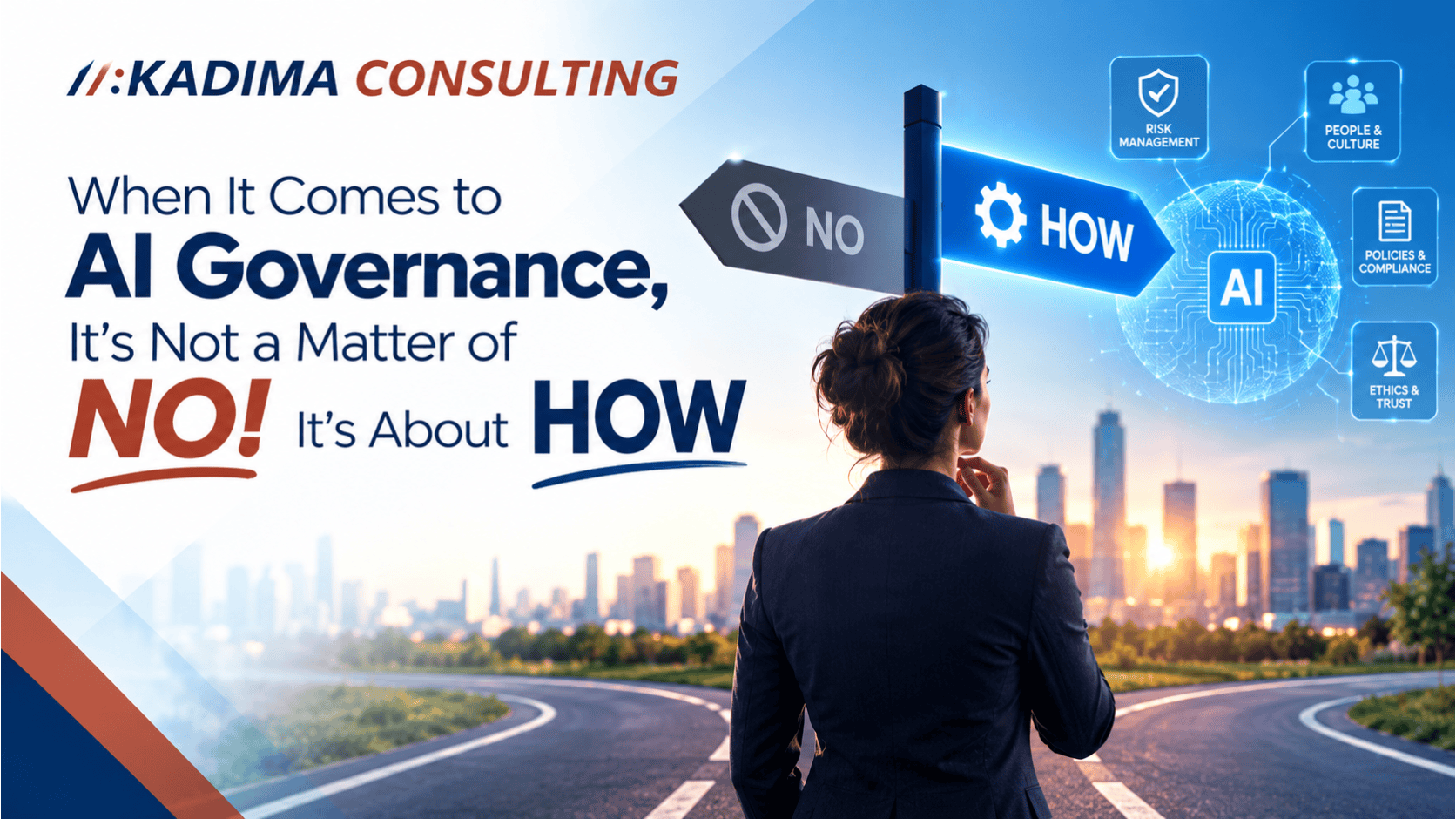
The best AI governance programs don’t begin with “No.”
They begin with:
“Yes, we’re embracing AI.”
“Yes, we’re empowering our people.”
“Yes, we’re doing it responsibly.”
Because successful AI governance isn’t about stopping innovation.
It’s about providing the framework that allows innovation to thrive.
About Kadima Consulting
At Kadima Consulting, we help organizations develop practical AI governance strategies that balance innovation, security, compliance, and business value. From AI Charters and acceptable use policies to Microsoft 365 Copilot readiness and adoption programs, we help organizations move from AI uncertainty to AI confidence.